
Confidence Beyond the Stage: How Dance Helps You Grow

The brightest moments in dance do not always happen under stage lights. Sometimes, confidence grows in quieter places: in the rehearsal room, backstage before a number, during corrections, or in the moment a dancer chooses to encourage someone else.
At ORO Dance Competition, confidence means more than trophies, scores, or applause. Those moments can be exciting and meaningful, but they are only one part of a dancer’s growth. The deeper kind of confidence is built through preparation, kindness, leadership, and resilience. It follows dancers long after the music stops.
That kind of confidence shapes how dancers carry themselves, how they treat others, and how they face challenges in every part of life.

Preparation teaches dancers to trust themselves
Confidence does not appear all at once. It grows each time a dancer shows up ready to work.
Preparation looks simple from the outside. A dancer packs the right shoes. They arrive on time. They stretch with care. They review choreography before rehearsal. They listen when a teacher gives notes. Yet those small habits build something powerful.
When dancers prepare, they learn that confidence is tied to effort. They do not have to feel perfect to feel ready. They can trust the time they have put in.
That trust matters on stage, of course. A prepared dancer can focus on performing instead of panicking about missed steps. But it matters off the stage too. The same dancer who learns to prepare for a routine can prepare for a test, a conversation, a new class, or a big life change.
Preparation also teaches responsibility. Dancers learn that their choices affect the whole group. When one person knows the counts, spacing, and transitions, the team can move with more ease. That sense of responsibility helps dancers understand that confidence is not only personal. It can support everyone around them.
Prepared dancers often become steady dancers. They may still feel nerves, but they know how to meet the moment.
Kindness builds the kind of confidence that lasts
Dance can be competitive, but the healthiest confidence does not come from putting others down. It grows when dancers learn to celebrate progress, theirs and others’.
A kind dancer notices when a teammate is nervous. They offer a smile backstage. They clap for another studio’s performance. They make room at the barre. They help someone remember a formation without making them feel small.
These moments may seem ordinary, but they build emotional strength. Kindness teaches dancers that confidence does not need to be loud or boastful. It can be calm, generous, and secure.
At competitions, this matters deeply. Dancers spend long days surrounded by other performers who have also worked hard. It can be easy to compare. One dancer may have higher extensions. Another may turn longer. Another may seem fearless. Kindness helps dancers shift from comparison to respect.
That shift changes everything.
When dancers respect the work of others, they become less afraid of someone else’s success. They begin to understand that another dancer’s win does not erase their own growth. This is one of the strongest lessons dance can teach.

Kindness also helps dancers build friendships rooted in trust. In a studio or competition setting, dancers often share vulnerable moments. They make mistakes. They try difficult skills. They perform while feeling nervous. A culture of kindness gives them room to grow without fear of being judged harshly.
That is the ORO spirit in action: dancers lifting each other as they rise.
Leadership can begin before a dancer feels ready
Leadership in dance does not always mean being the oldest, the most advanced, or the person standing in the center. Often, leadership begins with small choices.
A dancer shows focus when the room gets distracted. A teammate remembers to include someone new. An older dancer models respect for younger dancers. A performer accepts a correction with maturity. Someone checks in after a hard rehearsal.
These are leadership moments.
Many dancers wait to feel fully confident before they lead. Dance teaches them that leadership can start before that feeling arrives. They can take one brave step, then another. Confidence grows through the action.
Leadership also gives dancers a chance to use their voice. They may learn to ask a clear question, speak respectfully to a teacher, encourage a group, or help solve a problem during rehearsal. These skills reach far beyond dance.
They help dancers become people who can:
stay calm under pressure
communicate with care
take responsibility without needing attention
guide others while still learning
handle feedback with maturity
The best leaders in dance are not perfect. They are present. They pay attention. They make the room better.
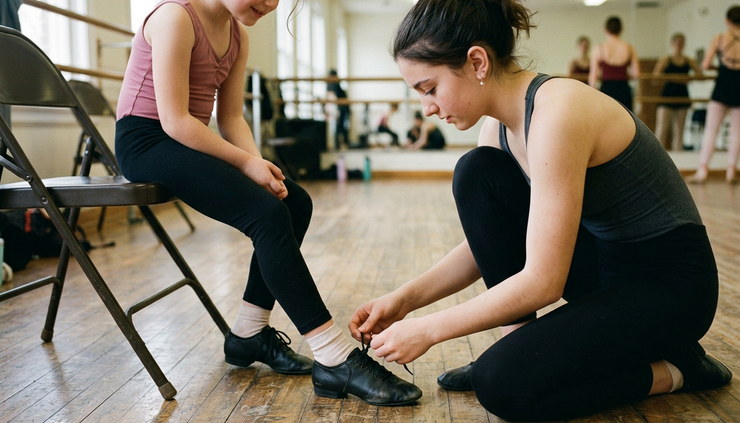
Through these moments, dancers learn that confidence is not a performance they put on for others. It is a steady belief that they can contribute, learn, and help.
Resilience helps dancers grow through the hard days
Every dancer faces difficult moments. A missed turn. A forgotten count. A disappointing score. A correction that feels frustrating. An injury that requires patience. A day when the body and mind simply feel tired.
Resilience is what helps dancers continue with care.
Resilience does not mean pretending everything is fine. It means learning how to respond when things do not go as planned. A resilient dancer can feel disappointed and still return to rehearsal. They can make a mistake and still finish the routine. They can receive feedback and use it to grow.
This lesson is one of dance’s greatest gifts.
Competitions can bring big emotions. Excitement, nerves, pride, and disappointment may all show up in the same day. When dancers learn to move through those emotions with support, they become stronger in a lasting way.
They begin to understand that growth is not always smooth. Some progress feels fast. Some takes time. Some lessons arrive through success, and some arrive through challenge.
Resilient dancers learn to measure themselves by effort, attitude, and growth, not only by results.
That mindset can stay with them for years. It can help them in school, friendships, work, and personal goals. Dance gives them a safe place to practice getting back up.
The ORO spirit lives beyond the performance
What happens on stage matters. Performance gives dancers a place to express themselves, celebrate their training, and feel the thrill of sharing their work. But the most meaningful growth often appears after the curtain closes.
It appears when a dancer thanks a teacher. When a team cheers for another studio. When someone handles a loss with grace. When a dancer who once felt shy helps a younger teammate feel welcome.
These are the moments that reveal character.

At ORO Dance Competition, the goal is not only to create moments of excellence on stage. It is to help dancers carry confidence into everyday life. The kind that shows up in preparation. The kind that chooses kindness. The kind that leads with humility. The kind that keeps going after a hard day.
True confidence is not just about how you shine on stage, it is about who you become off it.
By Yeni Guardado

Comments