.png)
Comparing Less, Growing More: Focusing on Your Own Journey

A dancer can finish a strong performance and still walk offstage thinking about someone else.
Maybe another dancer had higher extensions. Maybe a teammate landed a cleaner turn. Maybe the awards list did not match the effort that went into the routine. Comparison can sneak in quickly, especially in a world filled with competitions, videos, photos, and highlight reels.
But growth in dance does not come from chasing someone else’s path. It comes from paying attention to your own.
Every dancer brings a different body, story, training history, style, and spark to the stage. When comparison takes over, it can shrink that spark. When dancers learn to use inspiration without self-criticism, they make room for confidence, joy, and real progress.

Comparison is natural, but it does not have to lead
Dance is visual. Dancers learn by watching. They study lines, timing, musicality, control, and expression. Seeing another dancer perform beautifully can spark admiration, curiosity, and motivation.
The trouble starts when watching turns into ranking.
A dancer might think:
“They’re already better than me.”
“I should be farther along by now.”
“Why did they place higher?”
“My video does not look as good.”
Those thoughts can feel true in the moment, but they rarely tell the full story. No one sees every private lesson, every injury, every growth spurt, every hard rehearsal, every correction, or every quiet comeback.
Comparison often focuses on the final product. Growth happens in the work people do when no one is clapping yet.
A healthier mindset begins with one shift: notice what another dancer does well without using it as proof that you are behind. Admiration can stay admiration. It does not have to turn into self-doubt.
Competition can teach without defining you
Competition can be exciting, meaningful, and full of learning. It gives dancers a chance to perform under pressure, receive feedback, support teammates, and experience the energy of a live audience.
Still, scores and placements are only one part of the picture.
Judges see a routine once. They respond to what happens in that moment. A score may reflect technique, performance quality, choreography, timing, difficulty, or overall impression. It does not measure a dancer’s worth, potential, kindness, work ethic, or love for dance.
That matters.
A dancer can grow even when they do not place where they hoped. They can learn from critiques, notice patterns, and return to the studio with a clearer focus. They can also be proud of moments that judges may not know about, like dancing through nerves, remembering a difficult correction, or staying present after a mistake.
At ORO Dance Competition, the stage is a place to shine, not a place to shrink. The goal is to help dancers walk away with more than a result. Confidence, resilience, and self-respect last longer than a trophy.

Social media shows a highlight, not the whole rehearsal
Social media can be inspiring. It can introduce dancers to new styles, combinations, teachers, and performances. It can also make it easy to forget that most posts are selected moments.
A clean turn video may have taken many tries. A perfect leap photo may have been captured at the exact right split second. A glowing awards post may not show the disappointment, nerves, or exhaustion behind the weekend.
When dancers compare their daily practice to someone else’s best clip, the comparison is unfair from the start.
A better way to handle social media is to use it with intention:
Follow accounts that make dance feel exciting, not discouraging.
Take breaks when scrolling starts to affect confidence.
Save videos for learning, not self-judgment.
Remember that a post is not a full story.
Share progress because it feels meaningful, not because it needs approval.
Social media should support the dance journey, not control it. If a dancer leaves an app feeling smaller, that is a sign to pause and reconnect with the real work happening in the studio.
Personal goals make progress easier to see
One of the best ways to compare less is to measure something real. Personal goals give dancers a clear focus that does not depend on anyone else’s score, casting, or timeline.
A strong goal is specific enough to guide practice. “Get better at ballet” is too broad. “Hold my passé balance for eight counts on both sides” gives the dancer something to work toward.
Personal goals can include:
Improving turnout safely and consistently
Finishing arm lines with more intention
Taking corrections the first time
Building stamina for the full routine
Performing with stronger facial expression
Staying calm before going onstage
Dancing full-out in rehearsal, not only in performance
Small goals matter because they build evidence. A dancer can look back and see, “I used to struggle with this, and now I can do it.” That kind of proof is powerful.
Progress becomes easier to trust when it is tracked in personal wins, not only public results.
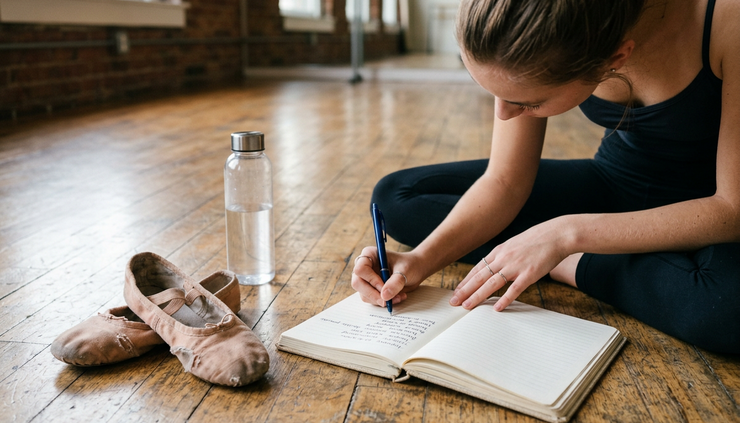
A simple dance journal can help. After class or rehearsal, write down one correction, one thing that improved, and one focus for next time. Over weeks, those notes start to show growth that memory might miss.
Inspiration feels different from comparison
Comparison often feels heavy. Inspiration feels open.
When dancers compare, they may feel tense, jealous, embarrassed, or defeated. When they are inspired, they feel curious. They ask better questions.
Instead of “Why can’t I dance like that?” try:
“What do I admire about that performance?”
“What skill could I practice from it?”
“How does that dancer use musicality?”
“What emotion did they make me feel?”
“How can I bring more of my own personality to my dancing?”
This turns another dancer’s success into a teacher, not a threat.
It also makes room for individuality. Two dancers can perform the same step and still look completely different. That is part of what makes dance beautiful. Line, energy, rhythm, presence, and emotion all carry personal flavor.
Trying to copy someone else exactly can hide what makes a dancer memorable. Learning from others is valuable. Losing your own voice is not.
Celebrate the quiet victories
Some of the most important dance victories do not come with medals.
They look like showing up after a hard day. Trying again after falling out of a turn. Asking a question in class. Smiling through nerves. Apologizing after frustration. Cheering for someone else even when the outcome stings.
These moments build character. They also build stronger performers.
A dancer who can celebrate small victories learns to stay connected to the process. That mindset helps during competition season, audition season, and everyday training. It creates a kind of confidence that does not disappear when results change.
Try ending each rehearsal or competition day with three reflections:
One thing I improved
One thing I learned
One thing I am proud of
The answers do not need to be big. They only need to be honest.

Your growth deserves your attention
Dance Your Own Journey Beyond Comparison means choosing to honor the path you are on, even when someone else’s path looks different. It means learning from others without losing trust in yourself. It means letting competition challenge you without letting it define you.
Every dancer has moments of doubt. Every dancer has strengths still growing. Every dancer has something special to bring to the stage.
So set the goal. Take the correction. Celebrate the small win. Cheer loudly for others. Then come back to your own work with an open heart.
Your journey. Your growth. Your moment to shine. 🌟
By Yeni Guardado


Comments